God
Thus Spoke ZarathustraGod is the absent authority whose death exposes a crisis larger than the loss of religious belief. In the madman’s proclamation, humanity has destroyed the power that once gave the world its orientation; in Zarathustra’s teaching, God is also a human creation, a projection that must give way to creative responsibility. The resulting void is perilous, but it opens the prospect of new values and the Superman.
The proclamation of God’s death
In the famous market-place scene, a madman arrives with a lantern in the bright morning, searching for God among people who do not believe in him. Their jokes treat the search as an anachronism: they suggest that God is hiding, lost, or travelling. The madman’s answer reverses their confidence. Even unbelievers, he insists, belong to the collective act that has killed God. His accusation makes disbelief more than a private change of opinion: it is an act with consequences for everyone who inherits the world afterward.
The madman describes those consequences through a sequence of images and questions. Humanity has, figuratively, drunk up the sea, erased the horizon, and unchained the earth from its sun. These images make the loss of God a loss of bearings: movement continues, but familiar directions such as up and down no longer seem secure. The scene’s repeated questions do not offer a new authority to replace the old one. Instead, they make the audience confront a world in which the former centre has disappeared and no settled orientation has yet taken its place.
The proclamation also gives the event a scale that exceeds the crowd’s immediate understanding. The madman imagines the burial of God and asks what act of atonement could answer humanity’s deed. The language of crime, burial, and purification presents the death as neither a simple liberation nor an occasion for easy celebration. It is a responsibility that the perpetrators may not yet be equal to. The madman’s claim that people born afterward will belong to a higher history makes the consequences reach forward: the deed has created a task for the future, not a finished doctrine for the present.
The old saint and Zarathustra
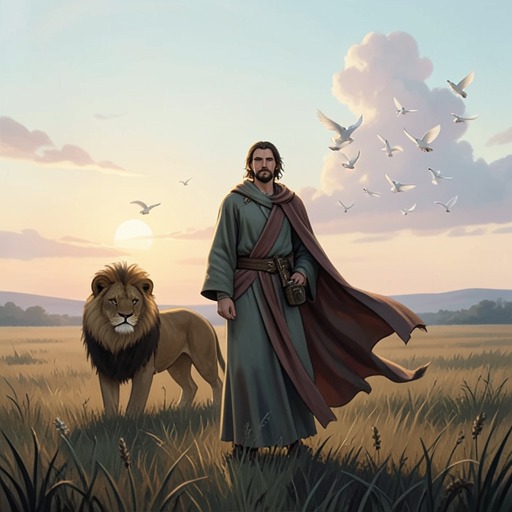
The gap between the proclamation and ordinary religious life appears when Zarathustra encounters an old saint in the forest. The saint praises his own God and asks what Zarathustra brings as a gift. Zarathustra declines to take anything from him and leaves quickly; the two part laughing like boys. Only when alone does Zarathustra recognize the decisive difference between them: the saint has not heard that God is dead.
The encounter does not show the saint changing his belief or learning of the proclamation. Instead, it places two ways of life beside one another without forcing them into agreement. The saint’s devotion remains intact within the forest, while Zarathustra carries knowledge of the historical and spiritual rupture beyond it. Their parting is friendly, but the difference is profound: a belief can persist in a secluded life even when Zarathustra understands the world beyond it as having entered a new condition. The scene also establishes that God’s death is not universally known or experienced at once.
God as a human creation
Zarathustra later turns the question from God’s disappearance to God’s origin. Looking back on his former conception of the world, he describes the divine as human work and human madness, not something received from beyond. God had been a phantom formed from his own fire and ashes. This account connects belief in a transcendent being to the believer’s own needs and imaginative power: what seemed to come from outside humanity had, in Zarathustra’s recollection, been made by humanity.
That recognition is part of a change in Zarathustra himself. He describes overcoming himself, carrying his ashes to the mountains, and making a brighter flame, after which the phantom fled. The movement is not simply from religious belief to disbelief. It is a transformation in which the old projection loses its hold as Zarathustra remakes himself. God’s disappearance therefore belongs to a struggle over what human beings create and whether they will recognize their creations as their own.
The same argument recurs when Zarathustra addresses his listeners about the Superman. He contrasts the earlier habit of saying God while looking at distant seas with the new demand to say Superman. God is a supposition, he argues, and supposing should not reach beyond the will to create. The world itself should be formed in the image of human reason, will, and love. This does not make the future a ready-made replacement deity: the emphasis falls on creating the world and the Superman, rather than appealing to another being beyond human activity.
Zarathustra’s reasoning becomes personal when he says that, if gods existed, he could not endure not being a god himself. He presents the conclusion that there are no gods as one drawn from this refusal, and then adds that the conclusion now draws him. The turn makes his argument more than an abstract proof: it binds his rejection of divine supremacy to the creator’s demand not to surrender the highest power of making and valuing. Yet he also acknowledges the anguish this supposition can impose, asking whether a creator can lose faith without dying and whether the eagle can be deprived of its soaring. The loss is presented as a serious ordeal, not a painless intellectual correction.
Pity, loss, and the old religious order
God’s relation to humanity is also recast through pity. In a teaching on the compassionate, Zarathustra recalls the Devil describing God’s love for humanity as his Hell, then reports the claim that God died of pity for man. The lines turn a conventional image of divine love inside out: compassion is not presented as an uncomplicated virtue, but as a burden capable of exhausting the one who feels it. Zarathustra’s warning against pity follows this account, while his contrast between pity and great love rests on creation: love, in his formulation, wants to create what it loves.
The idea returns later in the book, where its repetition gives it the force of a recurring interpretation rather than an isolated remark. In the conversation with the old pope, Zarathustra identifies himself as godless and asks whether the report that pity choked God is true. The pope responds that the one who loved and possessed God most has now lost him most, and wonders whether he is now the more godless of the two. The exchange links religious loss to intimacy: the pope’s service and love do not protect him from the consequences of God’s death; they make the loss more acute. The passage leaves Zarathustra’s question about how God died open in the supplied account, so the pope’s reflection should not be mistaken for a complete explanation.
After the death: danger and possibility
Among the Higher Men, Zarathustra calls God their greatest danger and declares that only after God has lain in the grave have they been resurrected. The language makes the end of divine authority a condition for their return, not proof that they have already fulfilled their potential. Zarathustra associates this opening with the great noontide and the prospect that the Higher Man may become master; he then gives the future its sharper direction: humanity now desires that the Superman shall live.
God’s death thus has two inseparable meanings in the book. It removes an inherited source of orientation and leaves humanity exposed to the threat of emptiness, but it also releases the possibility of creation that Zarathustra finds obstructed by belief in a transcendent ruler. Neither meaning cancels the other. The madman’s questions preserve the scale of the danger, while Zarathustra’s insistence on creating the world names a response. God remains central not as a speaking or acting character in these passages, but as the figure whose loss forces the question of what humanity will make of its freedom.